Intermission

Concert VI
Saturday, March 6, 2027 | 4:00 pm
Peace River Botanical & Sculpture Gardens
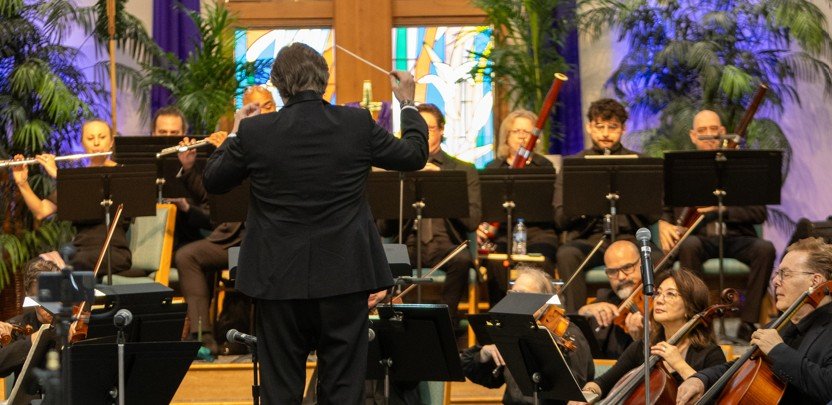
Experience an extraordinary performance in an unforgettable setting under the tent at the Peace River Botanical & Sculpture Gardens. Join the Philharmonic for Music from Around the World — a season-closing journey through the folk melodies, national voices, and dance rhythms of six continents’ worth of musical tradition.
Overture to Nabucco – Giuseppe Verdi (1813–1901)
Verdi’s 1842 opera tells the biblical story of the Israelites’ Babylonian exile, and its famous chorus “Va, pensiero” became an unofficial anthem of Italian national unity during the 19th century. The overture packs the opera’s dramatic contrasts — mournful and triumphant — into a single concert-opening blaze.
Preferred Seating .. $85 *
General Seating ….. $70
Student ………………. $10
Music Student …….. Complimentary
* Preferred Seating is located in designated premium seating areas closest to the orchestra.
Hungarian Dances Nos. 1, 3 & 10 – Johannes Brahms (1833–1897)
Originally written for piano four-hands, these dances were Brahms’s tribute to the Hungarian and Romani folk music he encountered through his friendship with violinist Eduard Reményi. They became some of the most popular concert works of the 19th century — so popular Brahms was even accused of plagiarism, since much of the material was borrowed folk melody rather than his own invention.
Finlandia – Jean Sibelius (1865–1957)
Composed in 1899 as a covert protest against Russian censorship of the Finnish press, this tone poem became such a powerful symbol of Finnish nationalism that Russian authorities briefly banned it from being performed under its own name. Its soaring hymn-like theme later became an unofficial second national anthem of Finland.
Intermission
Little Suite (Mała suita) – Witold Lutosławski (1913–1994)
Written in 1950–51, this suite draws on folk melodies Lutosławski collected from the village of Machów in southeastern Poland, transforming simple tunes — a fife song, a rowdy polka, a lullaby-like song, and a dance — into vivid, colorful orchestral miniatures.
Variations on “America” – Charles Ives (1874–1954), orch. William Schuman (1910–1992)
Ives wrote the original organ piece at just 17 years old, taking the tune of “My Country, ‘Tis of Thee” and twisting it through increasingly wild, irreverent variations — including a polytonal section combining two keys at once, decades before such techniques became common. Schuman’s orchestration turned Ives’s teenage experiment into a beloved orchestral showpiece.
Melodia – Myroslav Skoryk (1938–2020)
Composed for the 1982 Ukrainian film The High Pass, this deceptively simple, aching melody has become one of the most beloved works in Ukrainian music — performed by hundreds of orchestras worldwide and, in recent years, embraced as a powerful symbol of Ukrainian resilience.
“Oh Freedom” from Three Spirituals – Adolphus Hailstork (b. 1941)
The jubilant finale of Hailstork’s 2005 orchestral suite, which reimagines beloved African American spirituals through rich, sophisticated orchestration. “Oh Freedom” builds from fragmented brass and percussion into a triumphant, full-orchestra close — a fitting declaration to end the set.
Danzón No. 7 – Arturo Márquez (b. 1950)
Mexican composer Arturo Márquez has written nine danzónes celebrating the elegant Cuban-Mexican ballroom dance form; this one, from 2001, captures the sensuous sway and rhythmic sophistication that made his Danzón No. 2 an unofficial second national anthem of Mexico.
Hoe-Down from Rodeo – Aaron Copland (1900–1990)
Copland’s 1942 ballet about a ranch hand looking for love was scored for choreographer Agnes de Mille, and this rollicking finale — built on old American fiddle tunes — has become one of the most recognizable pieces of “American sound” in the repertoire, later famously repurposed in a beef industry ad campaign.